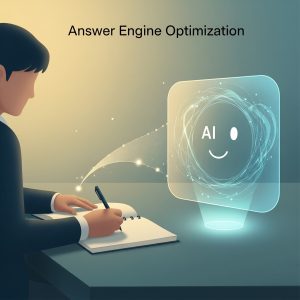
Answer Engine Optimization (AEO) – How to Write So AI Wants to Recommend You.
For years, marketers focused on one goal:
Rank higher in Google.
Today, there’s a new question:
How do you become the answer that AI tools like ChatGPT, Gemini, Perplexity, and others choose to recommend?
The answer isn’t to trick AI.
It’s to create content that is so clear, useful, and experience-driven that AI naturally recognizes it as a trustworthy resource.
That’s what Answer Engine Optimization (AEO) is really about.
AEO (Answer Engine Optimization) is the practice of structuring and optimizing content so that AI-powered tools — like ChatGPT, Perplexity, Gemini, and voice assistants — can easily understand, trust, and cite your brand as a direct answer to user queries.
It represents the evolution of traditional SEO in the AI-first era, with some marketers referring to it interchangeably as GEO (Generative Engine Optimization).
Answer Engine Optimization (AEO) isn’t about tricking AI. It’s about making your content so clear, useful, and trustworthy that AI systems naturally want to reference it.
The Core Difference: SEO vs. AEO
While traditional Search Engine Optimization (SEO) aims to drive users to click on a website link from a search results page, AEO focuses on getting your brand’s information surfaced directly inside AI-generated summaries and zero-click answer boxes.
| Feature | Traditional SEO | AEO (Answer Engine Optimization) |
| Primary Goal | Rank higher to drive clicks to your website | Be mentioned or cited in AI-generated answers |
| Success Metrics | Rankings, impressions, and Click-Through-Rate (CTR) | Brand mentions, AI citations, and Share of Voice |
| Target | Human readers scanning search engine lists | Large Language Models (LLMs) and AI algorithms |
| Strategy | Keyword density, backlinks, and domain authority | Clear answers, structured formatting, and topical authority |
Why AEO Matters for Marketers
As consumer search behavior shifts toward conversational, chat-based search, a growing percentage of searches end with no clicks for Google or other search engines. Users get the answer they need directly from the AI, skipping the traditional Google website priority listing we are so familiar with.
By securing citations within these answers, brands build awareness and consideration at the very start of the buyer’s journey. Writing in real human terms and words, the AI and its LLM will see the real you and your experience which are more than just word relationships.
Top Tactics for an AEO Strategy
To optimize your content for AI engines, marketers utilize a mix of the following strategies:
- Write Direct Answers: Place concise, 40-to-60 word definitions or answers at the very top of your content where AI crawlers can easily extract them. Pro-Tip: Use a “What is…” subhead followed immediately by a concise answer to help AI crawlers identify your content as the definitive source.
- Use Conversational Language: AI engines process natural language. Format your headings and content to directly mirror how a human speaks or types a question. Pro-Tip: Try reading your draft out loud; if you stumble over a sentence or it sounds too formal, an AI model will likely struggle to interpret it as “natural” for users.
- Implement Structured Data: Use clear headings, bulleted lists, and Schema Markup so machines can seamlessly parse relationships between topics and entities. Pro-Tip: Don’t overcomplicate it—simple bulleted lists and clear H2/H3 headings are often the best form of “unstructured” schema that LLMs parse most effectively.
- Build Broad Brand Consensus: AI systems look for trusted consensus across the web. Ensure your business is visible not just on your own site, but also in industry publications, on third-party review sites, and on community forums like Reddit. Pro-Tip: Think about where your ideal customers hang out online; being the helpful voice in those spaces establishes the topical authority that AI systems are trained to prioritize.
AEO Starts Before You Write
Think about your title/headline and what group of people would be interested in your response to it. Then outline your topics in a logical sequence. This is the part that AI might be able to help you with as the AI is good at organization and logical flow. And then your part is to think about how you will integrate your experience into each one or at least as many as possible.
Pretend you are writing to an acquaintance who might know something about your topic but not at the highest level. How would you write to him; conversational perhaps, using technical terms, or maybe a lesson learned from an experience you both had. Which would be better for the reader?
AI systems don’t simply count keywords. They evaluate context, clarity, and how well your content answers real questions.
Why Relationship Marketing May Be the Best AEO Strategy
AI doesn’t recommend content because it contains keywords.
It recommends content because it’s useful.
Useful comes from:
- Experience.
- Clarity.
- Authority.
- Trust.
- Relationships.
The more of these you have in your writing, the more valuable you are seen by AI and it’s LLM. Personal examples are powerful if in context of the question or topic at hand.
I think we need to stop thinking about:
SEO
or
AEO
Instead think about:
HEO
Human Experience Optimization.
No, that’s not an industry term (yet). 😊
But hear me out.
If you consistently write from real experience, organize your content clearly, answer genuine questions, and help readers solve problems…
Write Like You’re Helping One Person.
Human Experience Optimization means writing from experience instead of simply assembling facts.
It means sharing lessons you’ve learned, mistakes you’ve made, and practical advice you’ve tested.
AI can summarize information.
Only you can summarize your experience.
You’ll naturally improve your chances with both:
- Search engines
- AI answer engines
Because you’re optimizing for the person first.
The algorithms have been moving in that direction for years.
AEO in Brief
- Focus on Clarity: AEO is about being useful, not tricking the algorithm.
- Optimize for Answers: Use direct answers, conversational language, and clear headings.
- Prioritize HEO: True authority comes from ‘Human Experience Optimization’—infusing your unique, personal experience into every piece of content.
Lesson Learned
I learned this years ago that you always need to pull out the most important lesson. Applies to classrooms, sports, work, etc. This might become one of your cornerstone ideas:
- Don’t write for Google.
- Don’t write for AI.
- Write so clearly and so helpfully that both Google and AI can confidently recommend your work to real people.
That’s a philosophy I think will still be true five years from now, even though the technology will undoubtedly change.
And it fits perfectly with the direction we’ve been moving:
Build Assets. Build Relationships. Build Trust.
Those three principles are just as relevant for AEO as they were for email marketing 20 years ago.
If you’re ready to start building those assets and relationships using simpler, calmer systems, you can explore the Simpler Marketing AI guide to see how I apply these principles to daily communication.