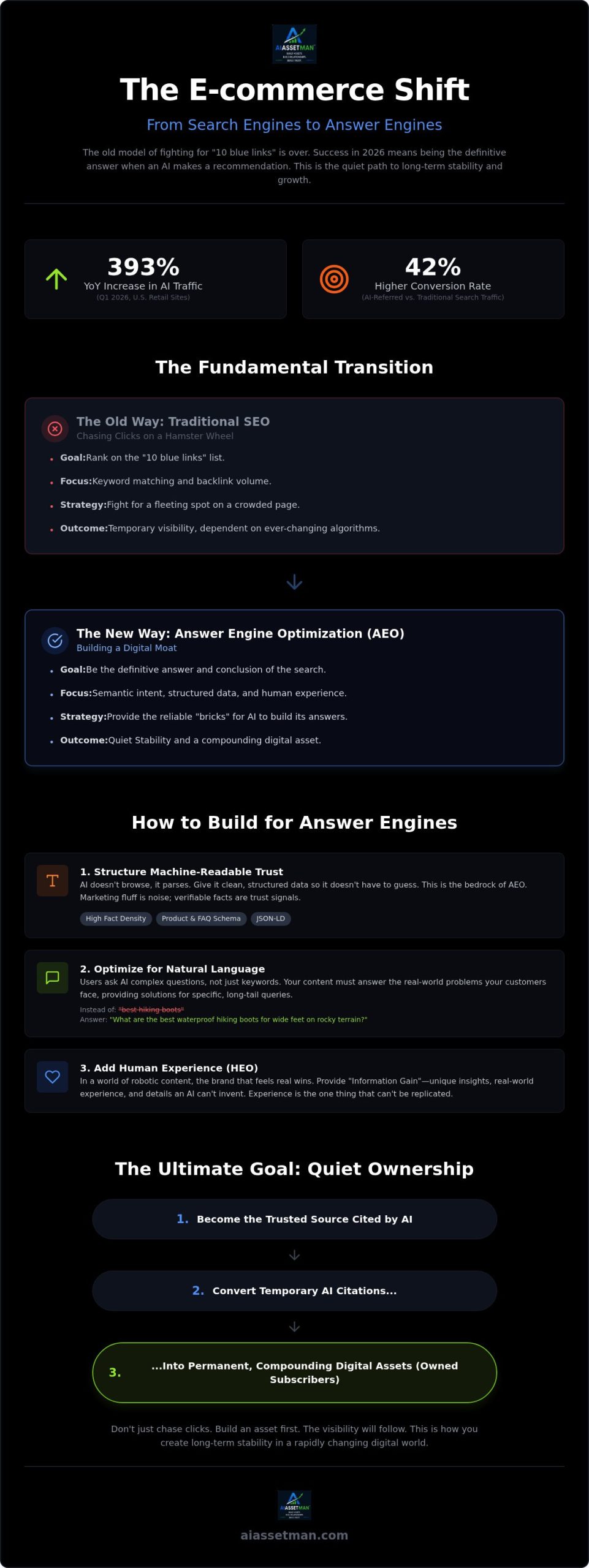
AI traffic to U.S. retail sites saw a 393% year-over-year increase in the first quarter of 2026. You’ve likely felt the ground shifting. Implementing effective AEO strategies for e-commerce sites is no longer a futuristic luxury. It’s the quiet path to stability. The old hamster wheel of traditional content marketing is spinning faster, yet the results feel thinner. It’s easy to feel overwhelmed by technical jargon like JSON-LD or the fear of being left behind by rapidly evolving LLMs. You want visibility that drives actual sales, not just another complex metrics report.
The good news is that you don’t need to be a loud disruptor to win. In March 2026, AI-referred visitors converted 42% better than traditional search traffic. We’ll show you how to master the shift from search engines to answer engines with a grounded, human-centric strategy. This isn’t about chasing trends. It’s about building long-term digital assets that work quietly in the background. We’ll explore how to structure machine-readable trust and use human experience to secure your place in AI Overviews. It’s time to build a strategy that compounds while you focus on your business.
Key Takeaways
- Understand the fundamental transition from traditional search ranking to becoming the definitive response in the age of answer engines.
- Implement technical AEO strategies for e-commerce sites that utilize machine-readable data to build a foundation of trust with AI models.
- Master Human Experience Optimization (HEO) to create content that provides unique insights and “Information Gain” that robots cannot replicate.
- Learn the “Quiet Ownership” framework to convert temporary AI citations into permanent, compounding digital assets and owned subscribers.
- Follow a structured roadmap to audit your store’s discoverability and build a digital moat that protects your brand’s long-term growth.
Beyond the 10 Blue Links: The E-commerce Shift to AEO
The era of the “10 blue links” is fading into the background. For years, e-commerce success meant fighting for a spot on the first page of Google. Now, the interface has changed. In 2026, answers are the new currency. When a shopper asks an AI for a recommendation, they don’t want a list of websites. They want a solution. This is where Generative Engine Optimization (GEO) meets the practical world of e-commerce. The goal isn’t just to be found; it’s to be the conclusion of the search.
The Rise of the Answer Engine
Large Language Models (LLMs) like Gemini and Perplexity don’t just find pages. They synthesize data. They read your product descriptions, customer reviews, and technical specifications to build a coherent response. Zero-click searches aren’t a threat anymore. They’re the standard. If your store isn’t the primary source of the answer, you’re essentially invisible. Effective AEO strategies for e-commerce sites focus on semantic intent rather than simple keyword matching. It’s about being the most trusted, machine-readable choice for the engine to cite. Think of it as providing the “bricks” for the AI to build its house. If your data is messy, the AI will look elsewhere for a sturdier foundation.
Why Traditional SEO Isn’t Enough
Traditional SEO is about ranking. AEO is about being the answer. Keywords might bring traffic, but answers bring customers who are ready to buy. The traditional SERP is declining in utility for high-intent shoppers. AI Overviews and ChatGPT are now the “front door” to your store. This shift requires a move from volume to value. You need to provide information gain. This means sharing unique insights, real-world applications, and human-centric details that AI can’t just invent. It’s about using technology without losing the human touch. In a world of robotic content, the brand that feels real wins the citation.
Fred often mentions the “Cart Before the Horse” mistake. Many store owners chase clicks before they build assets. They optimize for a fleeting algorithm instead of creating a stable digital presence. Chasing the latest hack is a hamster wheel. Building a digital moat through AEO is a long-term investment. It’s about quiet ownership. If you don’t own the data that feeds the answer, you don’t own the customer relationship. Robust AEO strategies for e-commerce sites ensure your brand is the foundation of the conversation, not just a footnote in a generated list. Build the asset first. The visibility will follow.
Structuring Machine-Readable Trust: Technical AEO Foundations
AI doesn’t browse your site like a human. It parses it. To an LLM, your website is a collection of data points. If those points are scattered, the AI guesses. If they are structured, the AI knows. This is the bedrock of AEO strategies for e-commerce sites. We call this machine-readable trust. It’s the difference between a pile of loose bricks and a finished wall. In 2026, the Universal Content Protocol (UCP) has become the standard for this exchange. It allows your product data to flow seamlessly into answer engines without friction.
AI favors facts. Marketing fluff is noise to a machine. High fact density means providing verifiable specs. Dimensions, materials, and shipping cutoff times are the signals AI looks for. Google’s April 2026 update to Merchant Center specifications proves this. Attributes like handling_cutoff_time and video_link are no longer optional extras. They are essential data points that build “Quiet Stability” for your digital assets. When your data is precise, the AI doesn’t have to hallucinate. It simply reports the truth you’ve provided.
Implementing Robust Schema Markup
Schema markup is the language of AI trust. It tells the machine exactly what a piece of data represents. Basic product schema is the bare minimum. To stand out, you need Review and FAQ markup. These layers provide context. JSON-LD acts as the structural integrity of your site. It’s clean, efficient, and machine-friendly. When you implement these technical layers, you aren’t just “optimizing.” You’re building a reliable asset that AI can cite with confidence. If you want to see how these systems work together, consider joining the AIAssetMan Builder’s Club to see the architecture in action.
Optimizing for Natural Language Queries
Shoppers don’t type “best hiking boots” into AI. They ask, “What are the best hiking boots for wide feet on rocky terrain?” Your content must anticipate these natural language queries. Focus on the “How,” “Why,” and “Best for” questions. Use TL;DR summaries at the top of your pages. These help AI engines extract your value proposition in seconds. Even your URL slugs matter. Keep them descriptive and human-readable. A clean slug like /best-waterproof-boots-for-winter is a clear signal to both humans and machines. This approach ensures your AEO strategies for e-commerce sites are built on a foundation of clarity and substance.
Human Experience Optimization (HEO): The Antidote to Robotic Content
Technical foundations provide the structure. Human experience provides the soul. While your schema markup tells the machine what your product is, your content tells the customer why it matters. In 2026, answer engines have become highly sensitive to “Information Gain.” This is a technical metric that measures how much unique value your content adds compared to the rest of the web. If you simply use AI to rewrite existing descriptions, your Information Gain is zero. AI prefers content that resonates with humans because that resonance produces better signals: longer dwell times, higher conversion rates, and genuine brand mentions.
Fred often reminds us that a real story about a product beats a 1,000-word AI description every time. Imagine a product page for a durable hiking boot. A robot can list the technical specs of the sole. A human can describe the specific sound that sole makes on wet granite. That specific, lived detail is something an LLM cannot invent. It’s the “Quiet Connections” pillar in action. By focusing on these human-centric details, your AEO strategies for e-commerce sites become more than just optimization. They become a competitive advantage that machines cannot replicate.
Bridging the Gap Between AI and Human
Robotic content is increasingly penalized by both users and answer engines. Shoppers are developing a “sixth sense” for generic, AI-generated fluff. When a user bounces, the AI takes note. It learns that your site didn’t actually solve the problem. To humanize your presence, focus on relationship-based AI marketing strategies. Use technology to handle the heavy lifting of data organization, but keep your brand’s voice grounded in real-world experience. This balance ensures you remain visible in AI Overviews while still closing the sale with a human buyer.
Leveraging Experience as a Competitive Edge
Older entrepreneurs often have a distinct advantage in the HEO era. You have decades of “Information Gain” stored in your head. You’ve seen products fail. You’ve heard the specific complaints of customers. This lived experience is your digital moat. Turn your product reviews into conversational trust signals by adding your own expert commentary. Use the “Human Check” for every piece of content you publish. Ask yourself: “Would I say this to someone over a beer?” If the answer is no, the content is too loud, too fake, or too robotic. Substance wins. Stability follows. This is the core of effective AEO strategies for e-commerce sites that stand the test of time.
Quiet Ownership: Turning AI Citations into Owned Assets
A citation in an AI Overview is a handshake. It’s not a contract. While visibility in answer engines is a vital start, relying solely on third-party mentions is building on shifting sand. Citations are fleeting. Subscribers are forever. The most effective AEO strategies for e-commerce sites don’t stop at being the answer. They use that visibility to move users into an inner circle. This is the “Quiet Permission” pillar. You’re shifting the relationship from a public platform to your owned ecosystem. In 2026, a direct human connection is the only hedge against algorithmic volatility.
An email list is the glue of a modern e-commerce business. It provides a direct line of communication that bypasses the noise of AI-curated feeds. By capturing the intent generated through AEO, you build recurring revenue streams. You’re no longer just a product recommendation. You become a trusted advisor. This transition allows you to compound your growth quietly, away from the frantic energy of traditional marketing. Ownership is the ultimate goal of the Strategic Architect.
The Value of a Subscriber vs. a Follower
Vanity metrics are a distraction. Many new store owners ask: do you need social media followers to start online? The reality is that followers are a rented audience on a platform you don’t control. Subscribers are an asset you own. AI makes your first-party data more valuable than ever. When you own the data, you can use AI to personalize the experience without relying on big tech’s shifting rules. You gain autonomy. You gain privacy. Most importantly, you gain a stable foundation for your brand.
Compounding Trust Through Quiet Stability
Platforms change. Email stays. This is the “Quiet Stability” principle in action. Your AEO strategies for e-commerce sites should act as a lead generator for your “Quiet Ownership” funnel. Fred often highlights the difference between renting an audience and owning an asset. Renters are always at the mercy of the landlord’s next policy change. Owners control their environment. By focusing on subscriber growth, you ensure that today’s AI visibility becomes tomorrow’s predictable profit. If you’re ready to start building your own digital assets, consider exploring the AIAssetMan Builder’s Club to learn how to secure your business future.
Building Your Digital Moat: The AEO Roadmap
Building a digital moat isn’t about high walls. It’s about building depth. The Strategic Architect doesn’t rush to publish more content. They audit for resonance. Does your store speak the language of AI trust and human experience? If not, you’re just adding noise to an already loud room. Effective AEO strategies for e-commerce sites focus on this quiet compounding. Small tweaks to your data structure and narrative style lead to long-term wealth. It’s a steady build. One brick at a time. This roadmap isn’t a sprint; it’s a structural reinforcement of your business autonomy and long-term stability.
Step-by-Step AEO Implementation
Execution requires a methodical pace. Start by prioritizing your high-value product pages. What are the most common questions your buyers ask? Answer them directly. Don’t bury the lead. Use the technical foundations we discussed earlier to make these answers machine-readable. Next, monitor your citations. Where are LLMs like Gemini or Perplexity pulling your brand name from? Off-site signals matter. Mentions on authoritative sites and customer reviews act as external validation. This isn’t about vanity. It’s about building a structural defense for your brand’s visibility.
The AIAssetMan Builder’s Club Advantage
You don’t have to build this structure alone. Mastering the shift to answer engines can feel like a solo trek through a dense forest. The AIAssetMan Builder’s Club provides the compass. It’s a community of like-minded builders who value substance over hype. Here, we focus on creating digital assets that work while you sleep. These aren’t fleeting marketing campaigns. They are structural components of a stable business. You gain the power of systems that work behind the scenes.
By going Inside the AIAssetMan Builder’s Club, you gain access to the refined paths we’ve already cleared. We prioritize the human element. We prioritize autonomy. This is the quiet revolution in digital wealth. Implementing AEO strategies for e-commerce sites within this framework ensures you stay ahead of the curve without the frantic energy of the crowd. You build. You compound. You own. That is the only way to secure a stable future in a shifting landscape. Substance wins. Stability remains.
Securing Your Store’s Future in the Answer Era
The landscape of 2026 requires a shift from chasing clicks to building substance. You’ve learned that technical foundations like Schema and UCP are just the bricks. The soul of your brand lies in Human Experience Optimization. By implementing these AEO strategies for e-commerce sites, you move beyond the noise of the SERP and into the clarity of direct answers. Remember that citations are fleeting. True wealth comes from converting that visibility into owned assets and recurring revenue.
Fred’s “Quiet Innovator” philosophy offers a simplified path. This is especially true for older entrepreneurs who value stability over frantic trends. You don’t need to be a tech wizard to succeed. You just need to be a Strategic Architect. It’s time to stop renting an audience and start owning your future. Join the AIAssetMan Builder’s Club to build your digital moat and connect with a community focused on long-term growth. Your steady, compounding build starts today.
Frequently Asked Questions
What is the main difference between SEO and AEO for e-commerce?
Is schema markup really necessary for my small e-commerce site?
Yes, schema markup is the essential language of AI trust regardless of your store’s size. It provides the machine-readable “bricks” that LLMs need to understand your inventory. Without it, AI systems have to guess your specs, which leads to hallucinations or exclusion. Implementing robust AEO strategies for e-commerce sites starts with basic Product schema and extends to Review and FAQ markup. This ensures your data is synthesized accurately by answer engines.
How can I tell if ChatGPT or Gemini is recommending my products?
You can monitor AI citations by tracking referral traffic from AI agents and checking brand mentions within LLM responses. Tools like Google Search Console now provide specific insights into AI Overviews. Additionally, searching for natural language queries related to your niche allows you to see if your store appears as a cited source. Tracking these Zero-Click mentions is a key metric for measuring the success of your digital assets in a shifting landscape.
Can I use AI to write my product descriptions and still rank in AEO?
You can use AI as a tool, but generic content often fails the Information Gain test. AI engines prefer unique insights they can’t invent themselves. If your descriptions are just rehashed versions of manufacturer specs, you’ll likely be penalized by both users and answer engines. The best AEO strategies for e-commerce sites involve humanizing AI-generated drafts with real-world experience. Lived details add genuine value that machines simply cannot replicate.
Do I need to be a technical expert to implement AEO strategies?
Citations are rented visibility, but an email list is an owned asset. While AI citations drive initial discovery, they are subject to the whims of platform algorithms. In 2026, first-party data is the only way to ensure long-term stability and recurring revenue. Moving users from a fleeting AI answer to your Quiet Ownership funnel allows you to build a direct relationship. This direct connection is the only hedge against algorithmic volatility.
What is Human Experience Optimization (HEO) in e-commerce?
HEO is the practice of creating content that resonates deeply with human needs and emotions. It serves as the antidote to robotic, mass-produced AI content. By providing unique insights and real-world stories, you satisfy the Information Gain requirements of modern answer engines. HEO ensures that when an AI recommends your product, the human on the other side feels a connection. This resonance leads to better conversion rates and long-term brand loyalty.
How does the Universal Content Protocol (UCP) affect my online store?
UCP is the 2026 standard for seamless data exchange between your store and AI agents. It ensures that your product information and availability are perfectly machine-readable. By adopting UCP, you reduce friction for AI shoppers making purchasing decisions. It turns your store into a stable node in the commerce ecosystem. This allows your assets to compound value quietly without manual intervention. It’s a foundational step for any serious e-commerce owner.