Ready-to-Sell Online Courses: Strategic Turnkey Guide
The most expensive mistake in the digital economy is believing you must build every single brick of your business from scratch. If you are spending months filming videos while your bank account sits idle, you are a technician trapped in a loop. It’s exhausting. You want the asset. You want the income. But the tech-heavy burden of starting from zero is draining your momentum. We agree that your experience is your greatest value, but that doesn’t mean you need to mill the timber for every wall of the house.
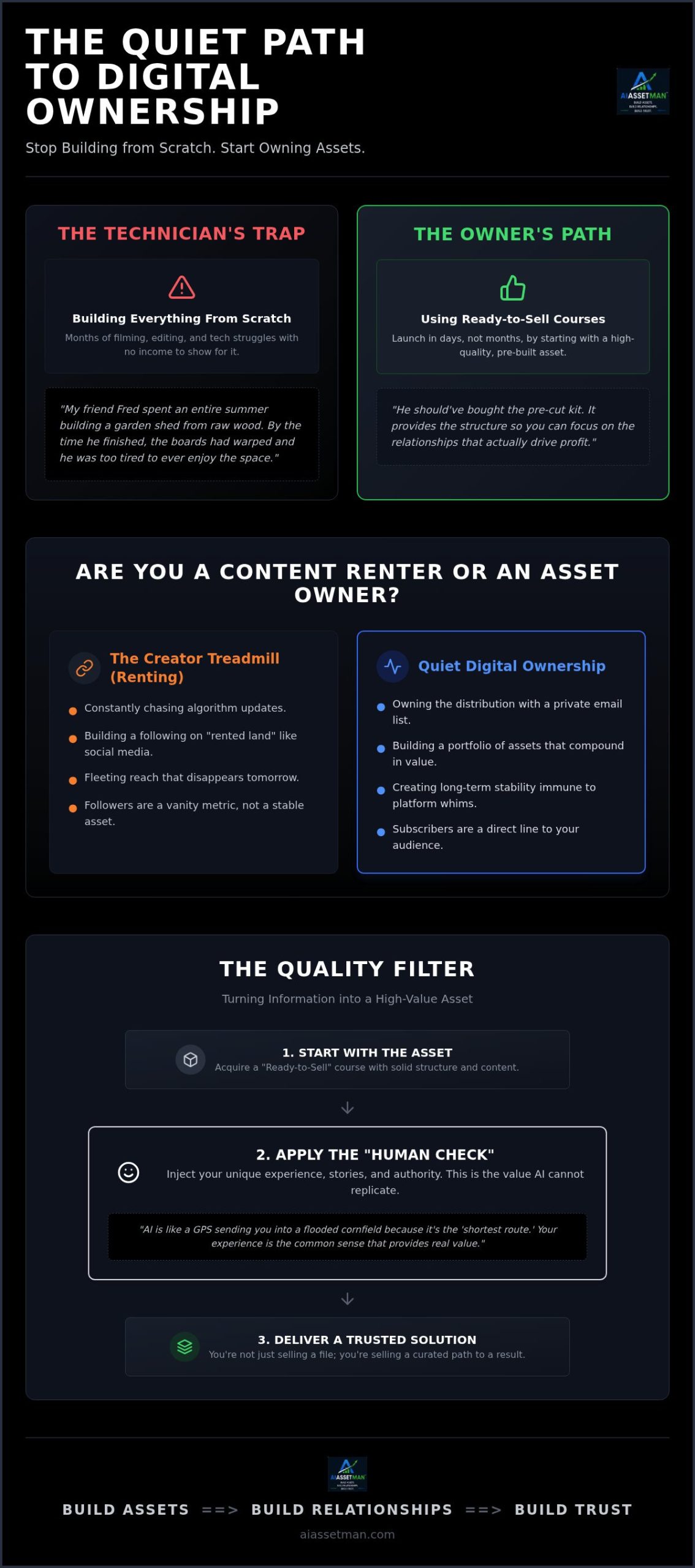
My friend once spent an entire summer trying to build a garden shed from raw, unseasoned wood. By the time he finished, the boards had warped and he was too tired to ever enjoy the space. He should’ve bought the high-quality, pre-cut kit. Using ready to sell online courses is that kit. It provides the structural integrity you need so you can focus on the relationships that actually drive profit.
This guide shows you how to leverage pre-built educational assets to generate recurring revenue without the content creation fatigue. We’re moving past the noise of social media and toward quiet ownership. You’ll learn to transform turnkey products into a relationship-based business built on trust and stability.
Key Takeaways
-
Shift from manual content creation to asset ownership by utilizing turnkey systems that prioritize your time and energy.
-
Apply the “Human Check” to every digital asset to ensure your unique experience provides the authority that AI cannot replicate.
-
Leverage ready to sell online courses to bypass the technical hurdles of filming and editing, allowing for a faster path to recurring revenue.
-
Prioritize “Quiet Ownership” by building an email list of subscribers who value your insight over the fleeting reach of social media followers.
-
Connect with a community of like-minded builders to navigate the evolving landscape of Answer Engine Optimization (AEO) and long-term business stability.
Table of Contents
What Are Ready-to-Sell Online Courses?
Most entrepreneurs confuse being a “creator” with being an “owner.” They spend months tethered to a microphone and a camera, trying to manufacture authority from thin air. A ready-to-sell online course is a strategic pivot away from that treadmill. These are turnkey digital assets. They arrive fully formed with a curriculum, video modules, and marketing materials. You aren’t starting from a blank page. You’re starting with a finished product that you have the right to rebrand and sell as your own. It is the difference between being the writer of a book and the publisher of a library.
My friend once decided to build a vacation cabin in the woods. He spent two full years milling his own logs and fighting with complex blueprints. By the time the roof was on, he was too exhausted to ever go hiking on the trails nearby. The next time he needed a structure, he bought a high-quality prefab. It was solid, well-engineered, and up in a week. He spent his time on the interior finish and the landscaping. Using ready to sell online courses is exactly like that. You get the solid structure immediately, so you can spend your energy on the “human finish” that builds trust.
The Turnkey Advantage for Retirees and Entrepreneurs
For those in the second act of their career, time is the most valuable currency. You have decades of experience. You don’t want to spend that time learning how to use a complex video editor or troubleshooting hosting lag. These assets allow you to launch in days, not months. It’s about reducing friction. You focus on the strategy and the relationships, not the pixels. This approach prioritizes Quiet Stability. You want a system that works behind the scenes while you enjoy your life. You can use relationship-based AI marketing strategies to add your voice to these assets without the tech-heavy burden of traditional production.
Understanding Digital Asset Ownership
There is a massive difference between being a content creator and a digital asset owner. Creators are on a platform treadmill, constantly chasing the next algorithm update. Owners have a portfolio. When you acquire Private label rights to a course, you own the distribution. You aren’t a tenant on someone else’s land. This is the core of Quiet Ownership. By owning the asset, you build compounding trust. You move people from the noise of public platforms into the sanctuary of your email list. If you’re wondering if you need social media followers to start online, the answer is no. You need ready to sell online courses that solve real problems and a direct line to the people who need them.
The Quality Filter: Passing the Human Experience Check
The “Human Check” is the simplest and most effective filter in your business. It asks one question: if you wouldn’t say this to a friend over a beer, should you be selling it? Many people treat ready to sell online courses as a hands-off commodity. They buy the asset and dump it onto a website without a second thought. This is a mistake. AI can organize information with incredible speed, but it cannot provide the weight of lived authority. Your experience is the filter that turns raw information into a high-value asset.
My friend once bought a GPS that insisted he drive through a flooded cornfield because it was technically the “shortest route.” The software had the data, but it didn’t have the common sense to see the water. AI-generated content often does the same thing. It follows a logical path that leads straight into a lake of generic, useless advice. When you evaluate a course catalog, you are looking for the “eyes” behind the information. You want substance that reflects real-world utility, not just a collection of noise that sounds professional but says nothing.
Avoiding the Robotic Content Trap
Low-quality course material is easy to spot once you know the signs. It often relies on repetitive sentence structures and vague, non-committal advice. If a lesson feels like it was written by someone who has never actually performed the task, your audience will feel it too. You can humanize a pre-made course by injecting your own observations and specific stories. This process creates “Quiet Connections.” It tells your subscribers that you have vetted the material and added your own layer of expertise. This is the core of Human Experience Optimization (HEO). You aren’t just selling a file; you’re selling a curated path to a result.
The Bridge Between Tech and Trust
Building a business that lasts requires “Quiet Compounding.” This is the slow, steady build-up of trust that happens when you consistently deliver value. To achieve this, you must use relationship-based AI marketing strategies to bridge the gap between technology and human touch. When you acquire intellectual property rights for a course, you are taking ownership of a structure. It’s your job to ensure the foundation is solid. Evaluate every curriculum for fluff. If a module doesn’t solve a specific problem or provide a clear “aha” moment, cut it or fix it. A smaller, high-impact asset is always more valuable than a bloated one. If you want to see how we filter for quality in a community setting, you might find the AIAssetMan Builder’s Club a useful place to start your journey.
PLR vs. White Label: Choosing Your Asset Framework
Choosing the right framework for your digital estate is about deciding how much of the “foundation” you want to build yourself. In the world of ready to sell online courses, the two primary paths are Private Label Rights (PLR) and White Label products. Understanding the legal boundaries is vital. With PLR, you typically acquire the right to edit the content, change the name, and keep 100% of the profits. It is the most flexible and affordable way to enter the market. White label assets are generally more polished, offering a finished, high-end experience that requires less “sanding” on your part. The Quiet Innovator understands that scale comes from owning the system, not just the content.
My friend once bought a “fixer-upper” sailboat because he loved the low entry price. He spent three full summers in his driveway replacing teak and fiberglass. He had a project, but he never actually saw the ocean. He eventually realized he could have bought a turnkey vessel and been sailing on day one. If you buy PLR without a strategy to finish it, you’re just buying a project. If you want to get on the water immediately, you look for an asset that is ready for the waves.
PLR Video Courses for Speed and Scale
PLR is the secret weapon for building “Quiet Permission.” It is perfect for creating lead magnets or low-cost introductory offers that invite subscribers into your world. In niches like automation or productivity, these assets allow you to test market demand without the $15,000 average cost of creating a course from scratch. However, don’t put the cart before the horse. Many entrepreneurs buy dozens of course packs without a system to deliver them. The goal is to build a relationship-based business. You can use these assets to provide immediate value to your list, proving that you don’t need social media followers to start online.
White Label Excellence for High-Ticket Assets
When you are ready to position yourself as a premium authority, high-production-value assets become necessary. You can find white-label online courses to resell that feature professional studio quality and deep curriculum design. These are high-ticket assets that provide Quiet Stability. They stay relevant because they are built on evergreen principles rather than fleeting trends. By investing in premium white label courses, you bypass the tech-heavy production phase and move straight to building trust. This is how you build a digital estate that compounds in value while you focus on the human connections that actually drive your business forward.

The Quiet Strategy for Selling Your Online Courses
Selling isn’t about volume. It’s about resonance. Many people buy ready to sell online courses and immediately look for a megaphone. They think more followers equals more profit. This is the “loud” mistake. The “quiet” strategy is different. It’s about moving from public noise to private permission. You don’t need a massive audience. You need an owned audience. This shift in perspective changes everything about how you deploy your digital assets.
The process follows a methodical, four-step sequence. First, you acquire the asset. Second, you humanize it with your unique experience. Third, you build your list. Finally, you compound trust through consistent value. This sequence turns technology into a tool rather than a master. It allows you to build a business that feels steady, grounded, and intentional. You aren’t chasing the algorithm. You’re building a foundation.
My friend once tried to organize a community garden by pinning flyers to every telephone pole in the county. He got plenty of “reach,” but zero gardeners. The next season, he simply sat on his porch and talked to three neighbors as they walked by. They didn’t just help; they took ownership of the project. That is the power of relationship over reach. When you focus on a few quiet conversations, you build something that lasts.
Owning the Audience (Quiet Ownership)
Followers are a rented commodity. They belong to the platform, not you. In the digital economy, subscribers are significantly more valuable because they have given you Quiet Permission to enter their inbox. Email is the glue that holds your digital business together. It provides Quiet Stability that social media can’t match. You don’t need social media followers to start online when you own the destination. You focus on building actual business assets rather than just generating temporary content.
Compounding Trust Through Experience
Validating your course material with personal stories or “Fredisms” is how you bridge the gap between tech and trust. It turns a digital file into a Quiet Connection. High-ticket sales aren’t made through high-pressure tactics. They are the natural result of trust that has compounded over time. The philosophy is simple: build assets to build relationships, and build relationships to build trust. When you use ready to sell online courses as your starting point, you have more time to focus on these human elements.
Ready to start building your own digital estate with a community that understands this philosophy? Explore the AIAssetMan Builder’s Club to connect with other quiet innovators.
Building Your Digital Estate with the Builder’s Club
Building a business in isolation is the fastest way to burn out. You have the ready to sell online courses and you understand the strategy, but the digital landscape is shifting. We are moving toward Answer Engine Optimization (AEO). AI is now the primary gatekeeper of information. In the AIAssetMan Builder’s Club, we don’t chase the latest “hacks” or loud marketing trends. We focus on building assets that answer engines recognize as authoritative and trustworthy. This is a community for the Quiet Innovator who values substance and structural integrity over fleeting social media fame. We provide the framework to turn information into a legacy.
My friend once joined a massive online marketing group with over 100,000 members. He thought the volume of people would mean a volume of wisdom. Instead, it was just 100,000 people shouting over each other to sell their own “secret sauce.” It was exhausting and yielded zero results. He eventually found a small group of retired engineers who were quietly building digital portfolios in the background. They didn’t shout; they just shared what worked. That is the spirit of the Builder’s Club. We prioritize stability and compounding growth over the frantic, high-pressure energy of the “hustle” culture.
The Quiet Revolution in Digital Wealth
The Builder’s Club is the antidote to the robotic, soul-less marketing that has flooded the internet. We believe that while AI can organize data, only your experience gives it credibility. By collaborating with other entrepreneurs who value Quiet Ownership, you gain a perspective that technology cannot replicate. Our vision is to create digital architects who own their audience and their assets. This long-term approach ensures that your business stays relevant even as platforms change. It’s about building a digital estate that serves you, rather than you serving the platform. We focus on the “Quiet” pillars of stability and relationship-based growth.
Getting Started with Turnkey Assets
Your first step is to pick a course that aligns with your specific lived experience. Don’t just pick what’s popular; pick what you can stand behind with authority. Once you have your first of many ready to sell online courses, the next step is integration. You can learn more about this approach through Fred’s AI Builder Philosophy. We help you move from being a buyer of courses to being an owner of a diverse digital portfolio. Start building your digital estate today by joining a community that values your time and your legacy. The path to quiet success is through assets, relationships, and trust. You can find your place in the AIAssetMan Builder’s Club and begin your journey toward low-friction, high-value ownership.
Take Ownership of Your Digital Future
True stability isn’t found in chasing the latest social media trend. It’s found in owning the land you build on. By leveraging ready to sell online courses, you skip the exhausting production cycle and move straight into the role of a strategic owner. You’ve learned that your experience is the essential filter. It turns raw information into a high-value asset. Focus on building quiet relationships through your email list. Stop shouting for attention on public platforms and start inviting subscribers into a space you control.
My friend once bought an old, neglected apple orchard. He didn’t spend his time trying to invent a new type of fruit. He spent his time pruning the existing trees and building a direct line to the local market. He focused on the health of the roots and the strength of the connections. That is the essence of Quiet Ownership. You don’t need to reinvent the wheel; you just need to own the wagon. If you’re ready to join a community of experienced entrepreneurs using HEO-compliant strategies, join the AIAssetMan Builder’s Club and start building your digital estate today. Your experience matters. It’s time to build something that lasts.
Frequently Asked Questions
Is it legal to sell courses that I did not create myself?
Yes, selling these assets is perfectly legal provided you have the correct licensing. When you acquire ready to sell online courses, you are typically purchasing Private Label Rights (PLR) or a white-label license. These agreements grant you the legal right to rebrand the content and sell it as your own. It is a standard business model used in many industries to scale production without increasing overhead.
How much can I change in a ready-to-sell PLR course?
You have the freedom to change as much as you want. Most successful owners keep the core curriculum but add a “human finish” to the modules. This might mean adding your own stories, updating examples, or simplifying complex sections. The goal is to ensure the content passes the Human Check. You want the asset to reflect your authority while the pre-built structure handles the heavy lifting.
Do I need a special platform like Teachable to sell these courses?
No, you aren’t restricted to any single platform. While white-label platforms exist with plans starting around $49 per month, you can also host these courses on your own website. The most important factor is ownership. You want a system that allows you to own the relationship with your subscribers. Prioritize Quiet Stability by choosing a setup that keeps you in control of your data and your brand.
Will AI search engines like ChatGPT recommend my pre-made course?
AI engines prioritize content that demonstrates lived experience and authority. If you simply upload raw files without any customization, you might stay hidden in the noise. However, by applying HEO-compliant strategies and humanizing the material, you improve your standing in Answer Engine Optimization (AEO). AI can organize data, but it recommends assets that show a clear, human connection to solving a problem or providing a result.
What is the “Human Check” for ready-to-sell courses?
The Human Check is a simple quality filter. If you wouldn’t say a sentence to a friend over a beer, it doesn’t belong in your course. My friend once bought a GPS that used such robotic language it told him to “execute a southern orientation” instead of just saying “turn left.” Don’t let your courses sound like that. Use natural language to build Quiet Connections with your audience.
How much does a high-quality white label course typically cost?
The cost of these assets is a fraction of the investment required for custom production. Research shows that creating a single online course from scratch can cost an average of $15,000. By choosing a turnkey asset, you bypass these massive development costs. This allows you to own a high-value digital asset immediately. You can then focus your resources on building relationships and compounding trust with your subscribers.
Can I use these courses to build a recurring membership site?
Yes, these assets are ideal for building recurring revenue. You can bundle multiple ready to sell online courses into a single membership library. This creates Quiet Compounding value for your members as they gain access to a growing portfolio of information. It is a steady way to build a relationship-based business. Your email list serves as the glue that keeps your members connected to your brand over the long term.
Do I need to be a tech expert to set up a turnkey course?
No, you don’t need to be a technician to succeed. These courses are designed to remove the tech-heavy burden of digital marketing. Most packages come with the curriculum and marketing materials ready for deployment. If you can manage an email list and follow a logical sequence, you can set up these assets. The focus remains on your experience and the relationships you build, not on your ability to write code.