
How to Get Featured in Google AI Overviews:
The Quiet Innovator’s Guide
When a Google AI Overview appears, users click a traditional blue link only 8% of the time. It is a staggering shift from the usual 15% click-through rate. You are likely wondering how to get featured in Google AI overviews so your business does not disappear into the digital background. It feels like the ground is shifting. The technical jargon is loud, and the fear of being replaced by a machine is very real for many seasoned entrepreneurs.
A blueprint shows you where the walls go, but it takes a master builder to know if the timber is seasoned enough to last a century. AI is the blueprint. Your life experience is the master builder. You can master the art of being recommended by Google’s AI by prioritizing human experience over technical noise. This is about building a quiet authority that compounds over time. This guide will show you how to turn your expertise into a stable business asset that AI wants to cite, ensuring your voice remains the one people trust while others are drowned out by the noise.
Key Takeaways
-
Understand why Google’s AI prefers “Quiet Authority” and substance over the frantic noise of traditional high-volume marketing.
-
Master how to get featured in Google AI overviews by using Human Experience Optimization (HEO) to ensure your content passes the “Beer Test.”
-
Build structural integrity into your pages with a clear roadmap of headings that helps Google’s LLM parse your professional expertise.
-
Inject personal observations and analogies—such as “seasoned timber”—to provide the human credibility that algorithms cannot replicate.
-
Transition from fleeting search visibility to “Quiet Ownership” by prioritizing your email list as your most stable and valuable business asset.
Table of Contents
-
Human Experience Optimization (HEO): The Strategy Behind the Bot
-
The Experience First Framework: 5 Steps to the Featured Spot
-
Beyond the Overview: Converting AI Visibility into Quiet Ownership
Understanding Google AI Overviews: The Quiet Opportunity
Google AI Overviews (AIO) have fundamentally reshaped the search landscape as of 2026. They now appear on approximately 50% of all U.S. search queries. This isn’t just a minor update; it’s a shift from a search engine to an “Answer Engine.” For the quiet innovator, this is a massive opportunity. Instead of shouting for attention in a sea of blue links, you can become the cited authority. Mastering how to get featured in Google AI overviews isn’t about gaming a system. It’s about being the most helpful person in the room.
Compare this to our local hardware store. There is a big-box shop down the road with a loud salesman. He knows where the hammers are, but he’s never built a deck in his life. Then there is Old Miller at the corner shop. He doesn’t shout. He listens. He tells you exactly why that specific bolt won’t hold in cedar. You don’t go to Miller because he is the loudest. You go because he is the expert. Google’s AI is looking for Miller. It wants the advisor, not the salesman. It prefers “Quiet Authority” over high-volume noise.
How AI Selects Its Sources
AI doesn’t pick names out of a hat. There is a strong correlation between ranking in the top 10 search results and being cited in an AIO. However, ranking alone is no longer the finish line. Google’s LLMs look for semantic relevance and “Experience.” Experience is the new currency. Understanding Google AI Overviews reveals that the system synthesizes information from across the web. It prioritizes sources that demonstrate genuine expertise. It is not about stuffing keywords. It is about substance. If your content feels like it was written by someone who has actually done the work, the AI will notice. This is the core of relationship-based AI marketing strategies. You must build assets that speak with authority.
The MOFU Advantage
AI Overviews dominate the consideration stage, often called the Middle of the Funnel (MOFU). This is where people compare options and look for real solutions. By being the recommended source, you move from “being found” to “being endorsed.” It is a subtle but powerful difference. You aren’t just another search result. You are the answer Google provided. This is how you build Quiet Stability. Position your digital assets as the logical conclusion to a user’s problem. When you provide clarity instead of noise, you earn the right to lead them toward your own audience platforms. You are no longer chasing traffic; you are attracting relationships.
Human Experience Optimization (HEO): The Strategy Behind the Bot
Many marketers spend their days trying to “crack the code” of an algorithm. They focus on technical noise. They forget the person on the other side of the screen. Learning how to get featured in Google AI overviews starts with a simple shift in perspective. We call it Human Experience Optimization (HEO). The goal is to write content that feels like a conversation, not a manual. If you wouldn’t say a sentence to a friend over a beer, delete it. This is the Beer Test. It is the ultimate antidote to the robotic, sterile content that AI is designed to filter out.
I talk about the “Cart Before the Horse” mistake. He once mentored a man who spent months obsessing over metadata and site speed before he even had a clear message. He had a beautiful cart, but no horse to pull it. In our world, your technical SEO is the cart. Your human experience is the horse. Without the horse, you aren’t going anywhere. AI needs the “horse” of your unique insight to decide that your content is worth recommending over a million other generic pages.
Humanizing Your Data
Dry facts are easy to find. Real stories are rare. When you share a personal observation, you create a “Quiet Connection” with your reader. AI can synthesize data, but it struggles to replicate the nuance of a lived experience. Use direct address. Speak to “you.” Use short, punchy sentences. This clarity makes your content easier for both humans and LLMs to parse. You aren’t just providing information; you are building trust. This is how you create a digital asset that compounds in value over time.
Bridging the Gap Between Tech and Value
Older entrepreneurs have a distinct advantage in this new landscape. You have decades of “seasoned timber” to draw from. While younger competitors might chase every new technical trend, you can focus on substance. You understand that relationships beat reach every time. This mindset aligns perfectly with relationship-based AI marketing strategies. We are seeing significant regulatory and structural shifts in search that favor authority and transparency. By avoiding technology for technology’s sake, you position yourself as a trusted advisor. If you want to build a business that lasts, consider joining the AIAssetMan Builder’s Club to focus on assets that truly matter.
Structural Integrity: Building Content AI Can Easily Parse
Structure isn’t just for engineers. It’s for clarity. While your expertise provides the substance, your site’s architecture provides the map. Mastering how to get featured in Google AI overviews requires more than good stories. It requires structural integrity. Think of your website like a well-organized workshop. If the tools are scattered, nobody can find what they need. Google’s Large Language Model (LLM) works the same way. It looks for a logical progression of ideas that it can quickly synthesize into an answer.
This is where “Quiet Compounding” comes into play. When you build with clear H2 and H3 tags, you aren’t just helping a bot. You are building a stable asset. These tags act as a roadmap. They tell the AI exactly what each section covers. Use scannable lists. Employ staccato fragments for emphasis. This rhythmic flow suggests efficiency. It shows you value the reader’s time. When you realize why followers don’t matter for starting online, you can shift your energy. Focus on building pages that serve as definitive resources rather than chasing fleeting social trends.
The stakes are high. A study from Carnegie Mellon University highlighted the impact on publisher traffic, noting that AI Overviews can cut clicks by nearly 40%. To survive this shift, your content must be the most “parsable” option available. You want the AI to see your page as the cleanest path to a solution. A messy toolbox is a sign of a slow job. The same applies to your code. If the bot has to work too hard to find the answer, it’ll just move on to your competitor.
The Anatomy of an AI-Friendly Page
Place your “Answer Engine” bait within the first 100 words. Be direct. Answer the core question immediately. Use tables and bulleted lists to provide structured data that machines love. At AI Asset Man, we prefer the “Page” format over the “Post” format for our cornerstone content. Pages remove the noise of sidebars and footers. They present a clean, focused environment. This structural choice signals authority. It tells Google this content is a cornerstone, not a passing thought.
Technical Foundations for the Non-Techie
You don’t need a computer science degree to have a fast site. Keep friction low. Site speed is a baseline requirement in 2026. Ensure your site architecture is clean and logical. Use Schema markup to label your data clearly. It’s like putting a clear label on every drawer in that workshop. This technical “Quiet Stability” ensures that as platforms change, your assets remain accessible and authoritative. You are building for the long term. You are building trust through order.
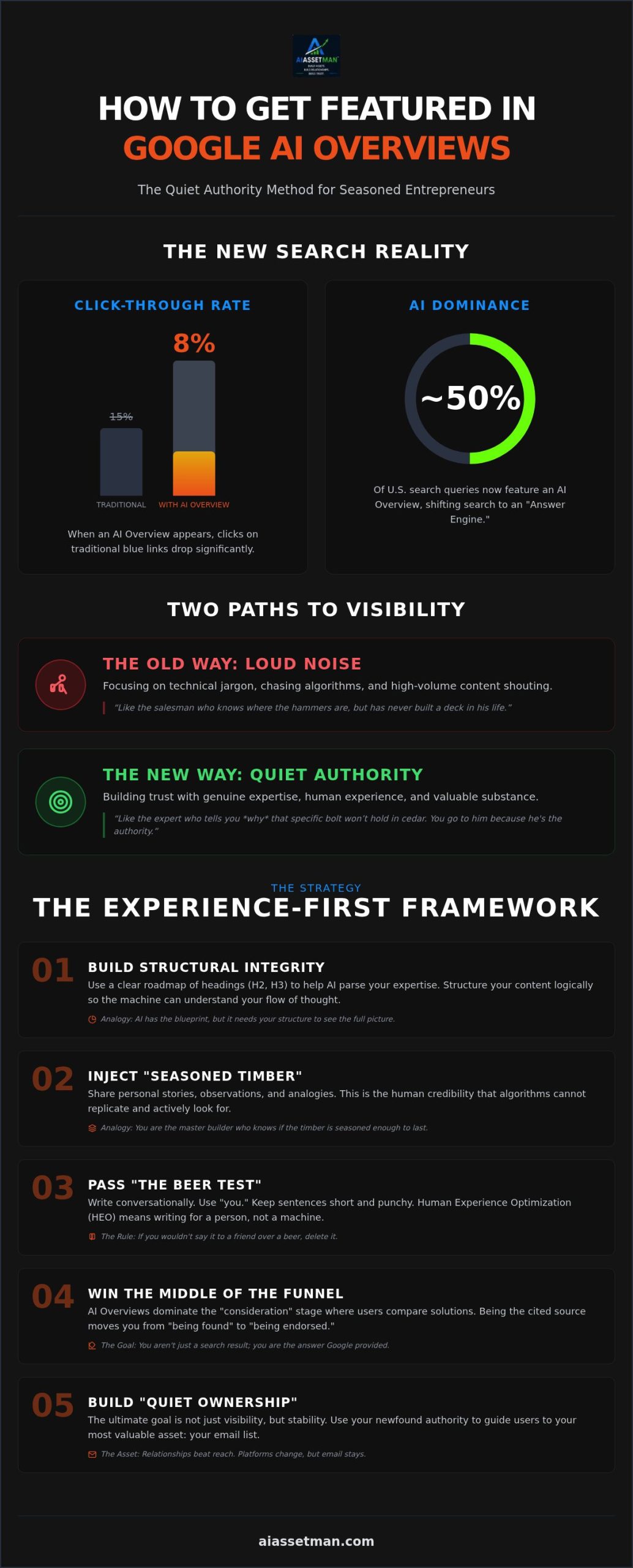

The Experience First Framework: 5 Steps to the Featured Spot
Generic advice often tells you to “just write good content.” That is subjective and unhelpful. If you want to know how to get featured in Google AI overviews, you need a repeatable framework. This isn’t about guessing. It is about building a structure that highlights your expertise while remaining easily digestible for an algorithm. Follow these five steps to position your assets for maximum visibility.
-
Step 1: Identify high-value questions. Informational queries trigger 88% of AI Overviews. Focus on the “how” and “why” questions that your ideal audience is actually asking.
-
Step 2: Inject unique “Fredisms.” Personal observations are your secret weapon. “Seasoned timber doesn’t warp under pressure.” Share an analogy or a story from your career that proves you’ve done the work.
-
Step 3: Optimize for “Quiet Permission.” Don’t shout at your readers. Invite them in. Use a tone that suggests you are a partner in their success, not just a source of data.
-
Step 4: Fact-check and verify. Google’s LLM prioritizes accuracy. If you make a technical claim, ensure it is backed by verifiable data. Hallucinations are for the machines; truth is for the experts.
-
Step 5: Review for “Human Flow.” Read your work aloud. Does it have a rhythmic cadence? Use the Beer Test. If it sounds like a textbook, start over.
Leveraging Your Unique Perspective
AI cannot replicate 30 years of business experience. It can summarize facts, but it cannot feel the weight of a difficult decision. Use this to your advantage. Analogies are excellent tools for simplifying complex AI concepts for your audience. They bridge the gap between sophisticated tech and human values. By sharing your lived experience, you build authority through “Quiet Relationships.” You become the trusted advisor who has already navigated the hurdles your readers are currently facing.
Optimizing for LLM Citations
To be cited, you must be quotable. Craft declarative, punchy sentences that summarize your core points. AI looks for these “nuggets” of wisdom to extract for its summaries. Avoid generic fluff that sounds like everyone else. Instead, provide nuanced answers that reflect relationship-based AI marketing principles. When you provide a unique, expert perspective, the AI is more likely to credit you as the source. Ready to build something that lasts? Explore our digital marketing philosophy to start building your authoritative digital assets today.
Beyond the Overview: Converting AI Visibility into Quiet Ownership
Visibility is a starting line. It is not the finish. If you focus only on how to get featured in Google AI overviews, you are missing the bigger picture. Traffic from search is a rental. It is volatile. It can disappear with a single core update or a shift in how LLMs synthesize data. True success comes from converting that temporary visibility into Quiet Ownership. You want to move your audience from Google’s platform to your own digital estate as quickly as possible.
This is what I call the “Quiet Revolution.” He often reminds me that a man who builds his house on a cliff shouldn’t be surprised when the tide comes in. Most digital marketers are building on the cliff of search rankings. We prefer solid ground. By owning your audience through an email list, you create Quiet Stability. You are no longer chasing the next click. You are building a relationship that lasts. This is the shift from being a tenant on a platform to being the landlord of your own business assets.
The Value of a Subscriber
AI makes information cheap. It makes impressions easy to get. But it also makes genuine human connection more expensive and rare. One email subscriber is worth 1,000 AI impressions. Why? Because a subscriber has given you Quiet Permission to speak to them directly. You aren’t competing with an algorithm in their inbox. You are building Quiet Connections through regular, valuable contact. As AI continues to organize the world’s information, your private audience becomes your most valuable asset. It is the only thing the machines cannot take away from you.
Building Your Asset Base
The long-term path for the “Quiet Innovator” is about building assets, not just generating content. You want systems that work behind the scenes while you focus on high-level strategy. This is the core philosophy behind the AIAssetMan Builder’s Club. Instead of worrying about one-off clicks, you should focus on recurring revenue and long-term trust. Use the traffic you gain from AI Overviews to invite people into your world. Offer them substance. Provide the experience-led credibility that AI lacks. When you own the relationship, you own your future. This is how you build a business that compounds over time, regardless of what the tech giants do next.
Build for Humans, Recommended by Machines
Success in this new era isn’t about chasing every technical phantom. It’s about substance. You’ve seen that mastering how to get featured in Google AI overviews requires a blend of structural integrity and genuine human experience. AI can organize the world’s data, but it cannot replicate the “seasoned timber” of your career. By focusing on Human Experience Optimization, you turn your knowledge into a stable asset that algorithms naturally want to cite.
A lighthouse doesn’t run all over the island looking for boats to save; it just stands there and shines. Your content should be that lighthouse. Be the expert. Be the trusted advisor. Then, use that visibility to invite readers into your own world through Quiet Ownership. This is how you build a business that compounds while others are distracted by the noise. You have the experience. Now, it’s time to build the structure that lets it shine.
Ready to build digital assets that compound? Join the AIAssetMan Builder’s Club today. Join a community for the intentional entrepreneur and secure your experience-led authority for the long term.
Frequently Asked Questions
What is the difference between SEO and AEO in 2026?
SEO focuses on ranking in the traditional list of blue links. AEO, or Answer Engine Optimization, is about becoming the direct answer provided by AI. By 2026, these two strategies have merged into one. You need the technical foundation of SEO to be found, but you need the clarity of AEO to be cited. It’s a shift from optimizing for keywords to optimizing for the intent of a human conversation.
Do I need a high-traffic website to be featured in AI Overviews?
You don’t need millions of visitors to be featured. Google’s algorithm focuses on the specific helpfulness of a single page. While ranking in the top 10 organic results is a strong signal, a “Quiet Innovator” can win by being the most authoritative source for a niche query. Focus on quality and substance. A smaller site with deep, experience-led content often beats a large site filled with generic noise.
How long does it take to see results from AEO optimization?
Changes can appear in search results relatively quickly. If your site is already indexed, structural updates to your headings and data might be picked up by AI features in a few weeks. However, the true results come from the compounding effect of trust. You aren’t just looking for a quick traffic spike. You’re building a stable business asset that provides consistent visibility as the search landscape continues to evolve.
Can AI-generated content get featured in Google AI Overviews?
AI-generated content can be featured, but it often lacks the credibility Google’s systems require. Machines are excellent at organizing data, but they cannot share a personal story or a unique business observation. This is where Human Experience Optimization becomes your advantage. If your content sounds like a robotic manual, it will likely fail the “Beer Test.” Google prefers to cite sources that demonstrate genuine human expertise.
What are the most common mistakes that prevent sites from being featured?
The biggest mistake is burying the answer under layers of fluff. If the AI has to hunt for the solution, it will move on to a competitor. Messy site architecture and a lack of clear headings also cause problems. Many entrepreneurs wonder why they struggle with how to get featured in Google AI overviews when they’re still making the “Cart Before the Horse” mistake. Clarity and structure are essential.
How do I track if my content is appearing in AI search results?
You can track your visibility by monitoring your brand’s presence in the citation cards within the overview box. Manual searches for your primary keywords are often the most accurate way to see how you appear. Some modern SEO tools also provide specific tracking for AI features. Focus on these citations as a key metric. They represent the “Quiet Authority” you’re building in your specific niche or industry.
Is getting featured in AI Overviews better than ranking #1 in organic search?
Both have value, but being featured provides an immediate endorsement from the search engine. When an AI Overview appears, users click the traditional results significantly less often. Being the cited source gives you a 120% boost in organic clicks per impression compared to other results. However, ranking #1 remains important for users who want to dive deeper into your site. The two results work together to build trust.
How does Human Experience Optimization (HEO) help with AI rankings?
HEO provides the “Experience” part of E-E-A-T that algorithms are trained to recognize. When you understand how to get featured in Google AI overviews, you see that Google wants to recommend humans, not just databases. HEO adds the analogies and lived experiences that make your content unique. This signals to the AI that your page is a high-value asset. It ensures your voice remains the one people trust.